
Global Plastics Treaty Negotiations Failed - What Went Wrong?
Geneva, Switzerland was ground zero for the final round of global negotiations that many had hoped would set the world on a course to end plastic pollution across the entire plastics lifecycle. The plan? Legally binding caps on global production, phase outs of chemicals of concern, promotion of sustainable design and circularity, a standardised Extended Producer Responsibility scheme, and a financial mechanism to back it all up. But hopes were dashed with the submission of a suspiciously low ambition draft text by the Chair, just one day before negotiations ended, which saw talks collapse and no consensus reached.
This was the sixth round of talks over three years of the Intergovernmental Negotiating Committee on Plastic Pollution (INC) – known as INC-5.2 – leaving many delegates and observers in frustration, whilst some others cited incremental progress and hope for potential future discussions.
Ocean Impact Organisation has not only been covering the progression of the Global Plastics Treaty, we even signed an open statement with a group of over 30 First Nations, environmental, and not-for-profit organisations calling for Australia to push for a strong treaty. So let’s break down global ambitions for an effective treaty, what actually happened at this last negotiating session, and what next steps could be.
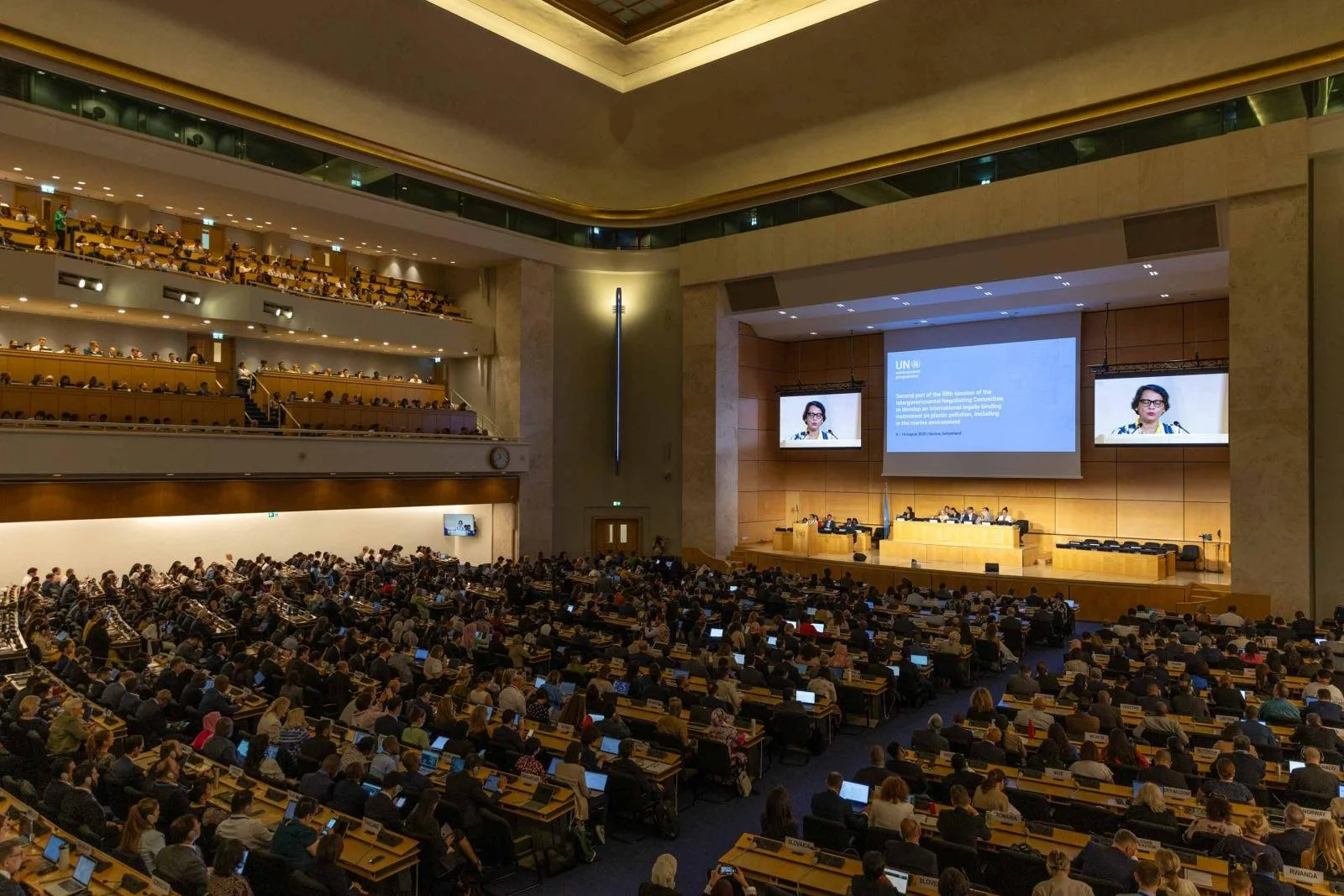
Delegates gather for the opening plenary on 5 August 2025. (Photo: IISD/ENB - Kiara Worth)
The ambition:
The science is clear, to be effective the treaty must tackle the entire plastics lifecycle, be legally binding, and include;
Caps on production, as well as bans and phase outs of the most problematic chemicals of concern and plastic products
Global product design requirements and systems to establish a non-toxic circular economy
Equitable financing and resources for systems change
And mechanisms to adapt and strengthen the treaty over time
WHy the treaty is Important
Under current projections, plastic production is expected to triple by 2060 if no intervention is made. This poses threats to economies, livelihoods, human health, the ocean, and the broader environment.
The CSIRO estimates that plastic pollution now costs about A$3.8 trillion a year.
Fossil fuel subsidies amounted to $7 trillion worldwide in 2022, or 7.1% of global GDP.
Researchers estimate that plastic pollution results in a 1-5% loss in marine ecosystem services annually, equating to around $500 billion to $2.5 trillion.
WWF estimates that the lifetime cost of just 1kg of plastic is 8x higher for low-and-middle income countries, despite them consuming almost 3x less plastic per capita than high income countries on average.
Under a business-as-usual scenario, the plastics lifecycle could be responsible for as much as 19% of global greenhouse emissions by 2040.
Plastic chemicals have harmful effects on health at every stage of life, and microplastics have been found in the blood, lungs, brains, placenta, breast milk, testicles, and bone marrow of humans.
What went wrong?
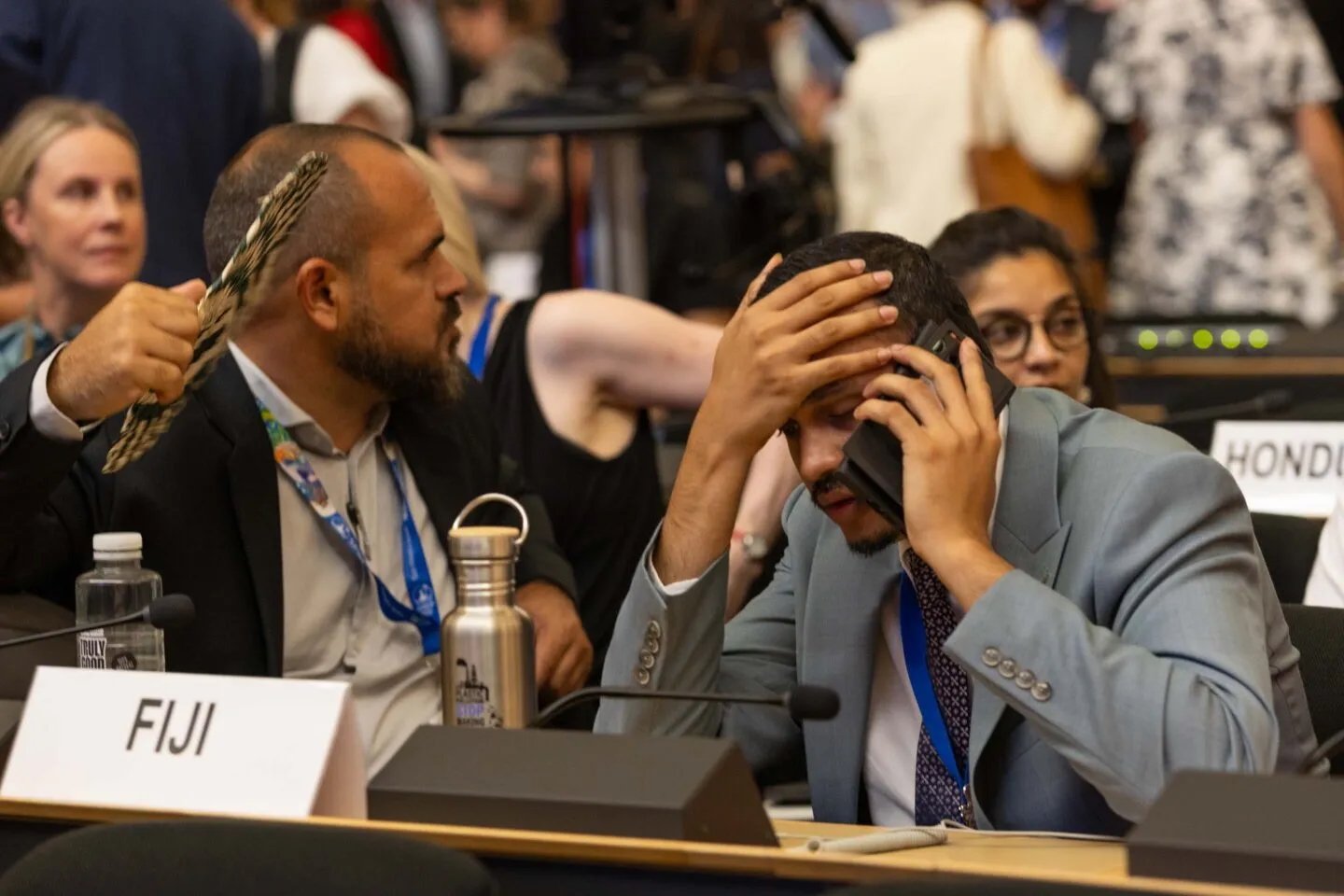
Delegates react to the suspension of the closing plenary on Thursday night at UN plastics talks in Geneva on 14 August 2025 (Photo: IISD/ENB - Kiara Worth)
High Ambition Coalition v Like-Minded Group
To understand why an agreement has remained seemingly out of reach despite the willingness of a large majority of member states, we need to understand two things:
The main point of contention: That the treaty must include mandatory plastic production cuts to be effective in addressing the mandate of ending plastic pollution.
And the two groups sitting on opposite sides:
The High Ambition Coalition (HAC), now totaling more than 75 nations – including Australia – across many regions and levels of development, who support a legally binding treaty covering the entire plastics lifecycle from cradle-to-grave.
And the Like-Minded Group (LMG), a smaller group of petrostates and major plastics producers – led by countries including China, Russia, Saudi Arabia, and with which the US is “aligned” – who want a voluntary agreement limiting the treaty’s scope “downstream” to waste management.
Unfortunately, all significant progress was blocked thanks to a treaty negotiation rule requiring consensus by all nations.
Lobbyists Overran Negotiations
Another factor in the breakdown of this latest round of plastics treaty talks was the record number of 234 lobbyists from the oil, petrochemical, and plastics industries in attendence. Making them the single largest delegation present.
To put this in perspective, lobbyists:
exceeded the combined delegations of all 27 EU member states – with 191 delegates
outnumbered the ‘Scientists’ Coalition for An Effective Plastic Treaty’ by three-to-one
outnumbered the ‘Indigenous Peoples’ Caucus’ by almost nine-to-one
According to the Centre for International Environmental Law (CIEL).
The number of lobbyists attending negotiations has steadily been rising since talks started in 2022, and whilst a spokesperson from the International Council of Chemical Associations (ICCA) said they were “outnumbered by more than 1,500 NGO participants,” this is a false comparison. Lobbyists have comparatively more power at the talks, with some;
embedded in government delegations – Egypt (6), Kazakhstan (4), China (3), Iran (3), Chile (2), Dominican Republic (1) – which help shape the treaty and gives them access to member-state-only sessions.
in informal advisory roles
lobbying during intersessional periods and through industry-sponsored unofficial side events around the talks.
This overwhelming, ever-increasing corporate influence came at a pivotal moment in treaty negotiations, and likely played a huge part in their collapse.
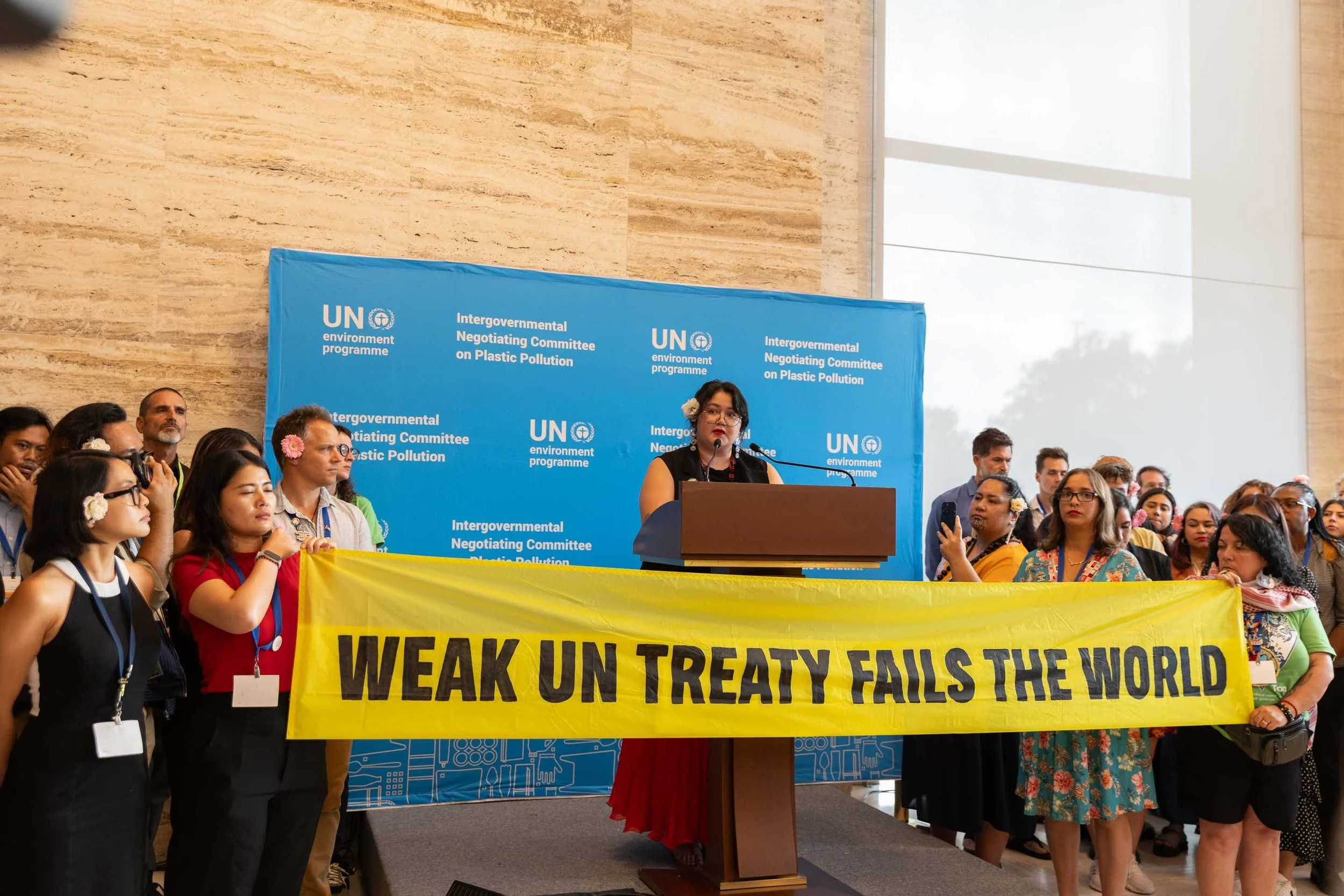
As delegates wait for plenary to begin, a media stakeout is held saying 'a weak UN treaty fails the world' (Photo: IISD/ENB - Kiara Worth)
The draft text that derailed it all:
A draft text released by the chair of treaty negotiations one day before the end of negotiations was shockingly weak. “This is not ambition, it is surrender,” said Panama’s delegate, Juan Carlos Monterrey Gómez, of the draft. Here's what was missing:
It did not contain an article on reducing or limiting production from a previous draft. In fact, it mentioned "production" only once – in the preamble.
A reference to the “full life cycle” of plastics in a previous draft was also removed.
It provided no legally binding measures on anything – providing only for voluntary, nationally determined commitments.
It contained no obligation to contribute resources to the financial mechanism, and no numbers or funding targets were mentioned.
It did not address chemicals of concern used in plastic products; there was no mention of the word "chemicals" anywhere in the text.
Impacts on human health were framed as “potential health implications” and “risks,” despite a wealth of scientific evidence showing impacts are definite, not theoretical.
It omitted any mention of youth, impacts on future generations, gender, inequality, or Indigenous people.
Contained no mention of development and scale-up of safe, toxic-free, and accessible reuse & refill systems
It did not include the words emissions, climate, fossil fuels, or even single-use plastics.

The sun rises over Lake Geneva on 15 August 2025, reminding delegates that hope remains and a solution will be found. (Photo: IISD/ENB - Kiara Worth)
What Happens Next?
Despite these setbacks, there’s still hope for a strong Global Plastics Treaty. But it’s likely to take time. After all, the High Seas Treaty took more than a decade of talks and negotiations. And while we don’t have a decade to take action on plastic pollution, if anything we need to speed up, it shows that the process can be complicated.
Currently, no next steps for future Global Plastics Treaty negotiations have been announced. But there are other potential paths forward:
HAC members could go ahead with a UN agreement by the willing coalition, establishing an accord on a regional or worldwide level. This was was done with the Ottawa Treaty to ban land mines, when parties to the Convention on Certain Conventional Weapons (CCW) — a consensus-driven forum in Geneva — couldn’t reach an agreement. A process which was, arguably, multilateralism at its best.
Or they could pursue other avenues outside the INC to reach an agreement. Such as adding a plastics regulatory provision to an existing UN treaty, such as the Basel Convention on Hazardous Waste, through the UN General Assembly.
Or in a move deemed more extreme, nations could take a vote outside the INC. For example, the UN Environment Assembly allows for a majority vote (rather than consensus).
Immediate actions:
In the absence of a strong treaty, what can we do?
As consumers, industry responds to public demand. Your choices matter. And shifts are often driven by popular pressure. From rejecting fast fashion, to embracing the circular economy, to supporting solutions like plastic alternatives. There are many ways we can show industry what we want.
Australia doesn’t need to wait for a treaty. And we shouldn’t. As a member of the HAC, and a country that isn’t a large producer of raw plastic polymers from fossil fuels, Australians consume more than 50kg of single-use plastic per person, per year. That’s more per capita than most other countries. Australia could lead by example.
Most importantly, we must keep the momentum going and show leaders that we want them to continue to fight for a strong Global Plastics Treaty for the benefit of all.